Doubleword logo black
Product
Products
Doubleword API
NEW
Inference built for scale
Doubleword Inference Stack
High performance inference stack
Use Cases
Async Agents
Long running background agents
Synthetic Data Generation
Generate high volumes of data for fine- tuning
Data Processing
Apply intelligence to large volumes of data
Resources
Documentation
Technical docs and API reference
Workbooks
Ready-to-run examples
Seen in the Wild
Community content and projects
Resource Centre
All our blogs and guides
Technical Blog
Our blog on building inference systems
Al Dictionary
Key Al terms explained
Savings Calculator
See how much you save with Doubleword
Solutions
By Deployment Option
On-premiseCloudHybrid
By Team
AI, ML & Data SciencePlatform, DevOps & ITCompliance & Cyber
Pricing
Docs
Pricing
Get started - Free
Get started - Free
Resources
/
Blog
/
Taming Enterprise RAG: Essential Tips from TitanML's CEO for Efficient AI Infrastructure
August 7, 2024

Taming Enterprise RAG: Essential Tips from TitanML's CEO for Efficient AI Infrastructure

Rod Rivera
Share:
https://doubleword.ai/resources/taming-enterprise-rag-essential-tips-from-titanmls-ceo-for-efficient-ai-infrastructure
Copied
To Webinar
•

Highlights:

  • Self-hosting LLMs can provide cost savings, better performance, and enhanced privacy/security
  • Key tips: Define deployment boundaries, always quantize, optimize inference, consolidate infrastructure, plan for model updates, use GPUs, and leverage smaller models where possible
  • TitanML offers containerized solutions to simplify LLM deployment and serving at scale

Introduction

As large language models (LLMs) continue to revolutionize AI applications, many organizations are grappling with the challenges of deploying these models effectively. In a recent talk at the TMLS Summit in Toronto, Canada, Meryem Arik, CEO of TitanML, shared valuable insights on making LLM deployment less painful.

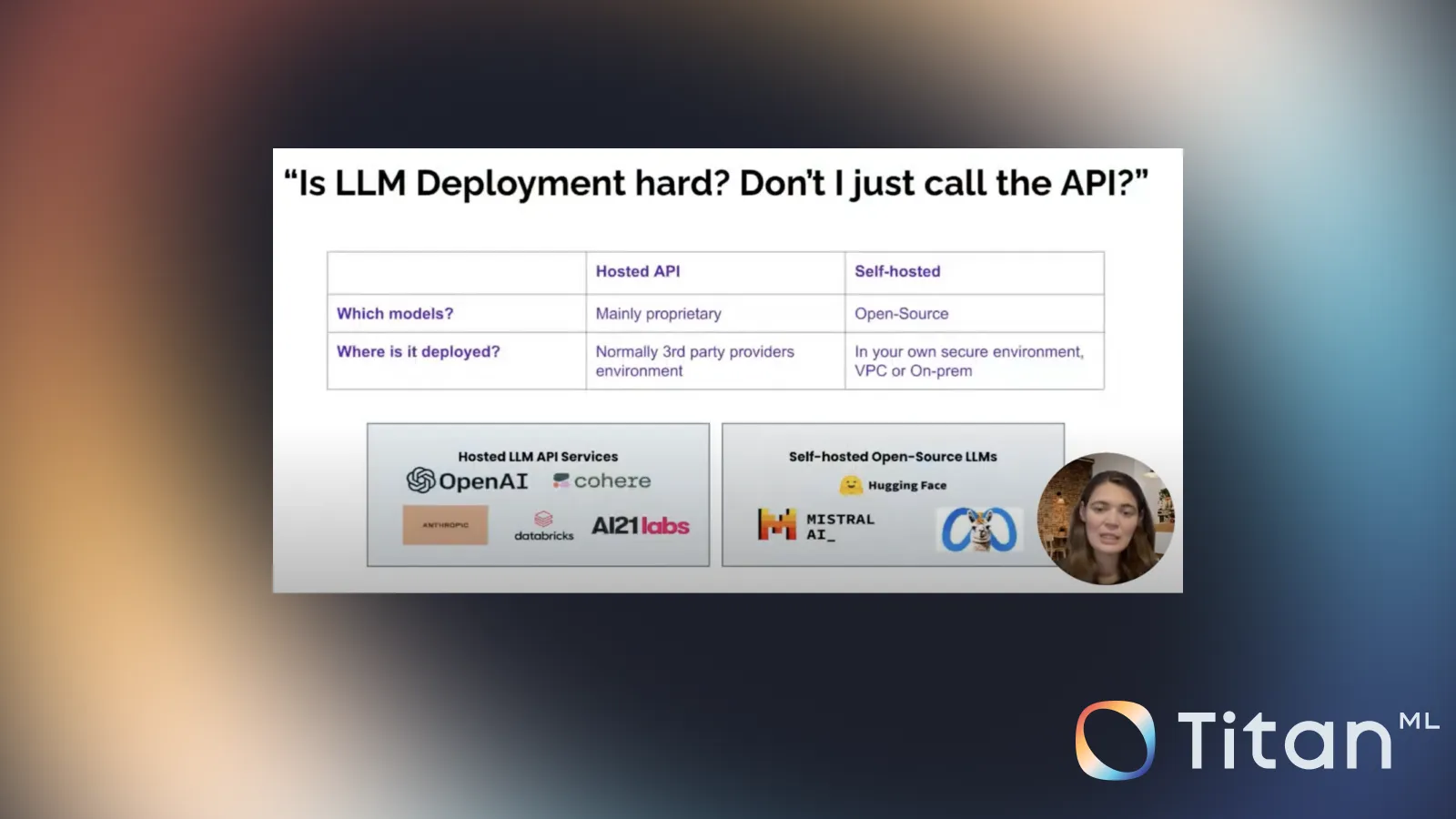
Is LLM Deployment hard? Don't I just call the API?

Why Self-Host LLMs?

While API-based services like OpenAI offer convenience, there are compelling reasons to consider self-hosting LLMs:

  1. Cost savings at scale: As usage increases, self-hosting becomes more economical.
  2. Improved performance for domain-specific tasks: Fine-tuned open-source models can outperform general API models.
  3. Enhanced privacy and security: Keep sensitive data within your infrastructure.

Enterprises are particularly interested in self-hosting due to the control, customizability, and potential cost benefits it offers.

The Challenges of LLM Deployment

Deploying LLMs is significantly more complex than traditional ML models for several reasons:

  • Model size: LLMs are extremely large, often requiring multiple GPUs.
  • GPU costs: Inefficient deployment can be very expensive.
  • Rapidly evolving field: New models and techniques emerge frequently.
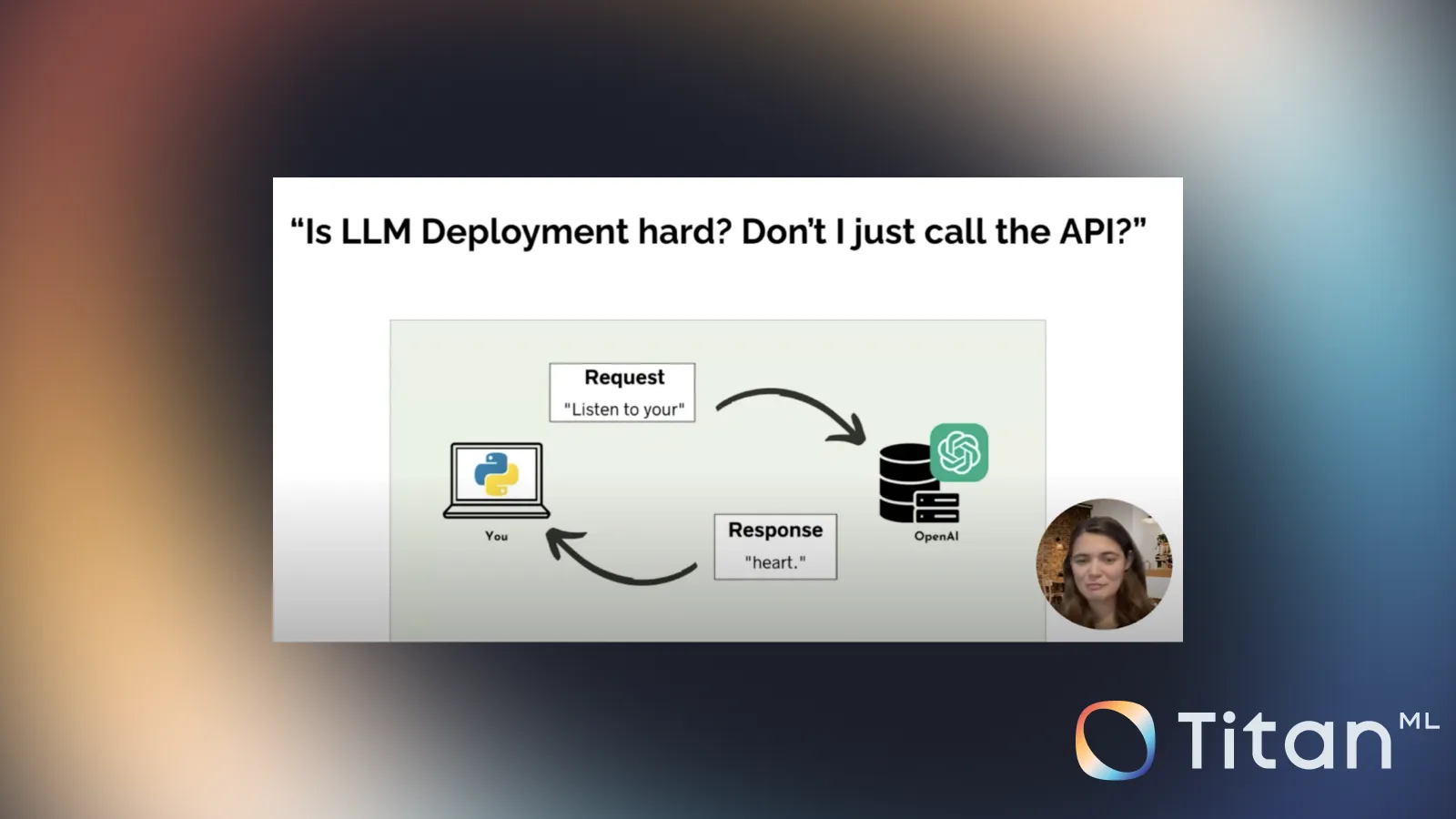
LLM Deployment is much more than just calling the API

7 Tips for Successful LLM Deployment

1. Define Your Deployment Boundaries

Before building or deploying, clearly understand your:

  • Latency requirements
  • Expected load
  • Hardware availability

Key takeaway: Knowing your constraints upfront makes future trade-offs more transparent.

2. Always Quantize Your Models

Quantization reduces model precision to decrease memory requirements. Research shows that for a fixed resource budget, 4-bit quantized models often provide the best accuracy-to-size ratio.

Key takeaway: Quantization allows you to deploy larger, more capable models on limited hardware.

3. Optimize Inference

Two critical optimization techniques:

a) Batching:

  • No batching: ~10% GPU utilization
  • Dynamic batching: ~50% GPU utilization
  • Continuous batching: 75-90% GPU utilization

b) Parallelism strategies:

  • Layer splitting (e.g., Hugging Face Accelerate): Inefficient GPU usage
  • Tensor parallel: Much faster inference with full GPU utilization

Key takeaway: Proper inference optimization can yield 3-5x improvements in GPU utilization.

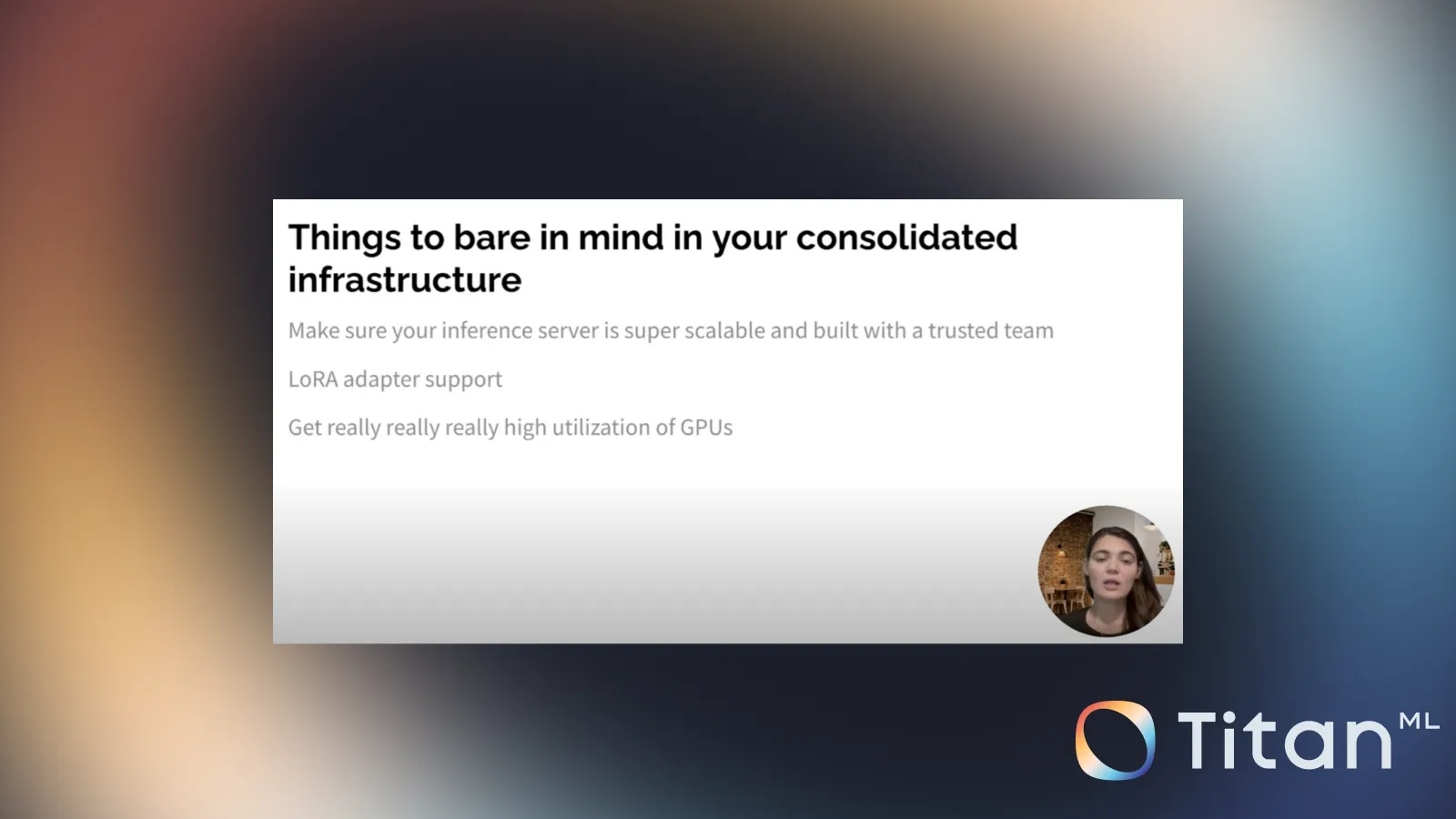
Things to bare in mind in your consolidated infrastructure

4. Consolidate Infrastructure

Centralize your LLM serving to:

  • Reduce costs
  • Improve GPU utilization
  • Simplify management and monitoring

Case study: TitanML helped a client consolidate multiple applications onto fewer GPUs, improving efficiency and reducing costs.

5. Build for Model Replacement

The state-of-the-art in LLMs is advancing rapidly. Design your applications to be model-agnostic, allowing easy swapping as better models emerge.

Key takeaway: Focus on building great applications, not betting on specific models.

6. Embrace GPUs

While GPUs may seem expensive, they are the most cost-effective way to serve LLMs due to their parallel processing capabilities.

Key takeaway: Don't try to cut corners by using CPUs; invest in GPUs for optimal performance.

7. Use Smaller Models When Possible

Not every task requires the largest, most powerful model. For simpler tasks like RAG fusion, document scoring, or function calling, smaller models can be more efficient and cost-effective.

Key takeaway: Match the model size to the task complexity for optimal resource usage.

TitanML's Solution

TitanML offers a containerized solution that simplifies LLM deployment and serving. This Enterprise Inference Stack provides:

  1. A gateway for application-level logging and monitoring
  2. An inference engine for fast, cost-effective serving
  3. An output controller for model reliability, safety, and agentic tool use

By abstracting away the complexities of LLM infrastructure, TitanML allows organizations to focus on building innovative AI applications.

Conclusion

Deploying LLMs effectively requires careful planning and optimization. By following these tips and leveraging tools like the TitanML Enterprise Inference Stack, organizations can harness the power of large language models while managing costs and complexity. As the field continues to develop, staying adaptable and focusing on building great applications will be key to success in the world of generative AI.

Ready to Supercharge Your LLM Deployment?

Don't let the complexities of LLM infrastructure hold you back from building innovative AI applications. The TitanML Enterprise Inference Stack can help you deploy and serve LLMs with ease, allowing you to focus on what really matters - creating value for your organization.

Take the Next Step: Experience the power of efficient LLM deployment firsthand. Reach out to us at hello@titanml.co to schedule a personalized demo. Let's unlock the full potential of your AI infrastructure together!

Footnotes

Table of contents:

Heading 2
Heading 3
Heading 4
Heading 5
Heading 6
"
Learn more about self-hosted AI Inference
Subscribe to our newsletter
Thanks you for subscription!
Oops! Something went wrong while submitting the form.

Stop overpaying for inference.

Teams use Doubleword to run low-cost, large-scale inference pipelines for async jobs.
‍
Free credits available to get started.

Get started - Free
Doubleword logo black
AI Inference, Built for Scale.
Products
Doubleword APIDoubleword Inference Stack
Use Cases
Async AgentsSynthetic Data GenerationData Processing
Resources
Seen in the WildDocumentationPricingAsync Pipeline BuilderResource CentreTechnical BlogAI Dictionary
Company
AboutPrivacy PolicyTerms of ServiceData Usage Policy
Careers
Hiring!
Contact
© 2026 Doubleword. All rights reserved.
We use cookies to ensure you get the best experience on our website.
Accept
Deny